CHAPTER ONE
The Girl Who Spoke Fire
Chapter One: The Girl Who Spoke Fire
The city had been going gray for three years, and most people had learned not to notice.
Mara had noticed. That was her problem.
She had started keeping a journal of it at first — a linguistics student's obsession, the kind of thing that looked like scholarship until you showed it to someone and watched their eyes go politely blank. She catalogued the places where color seemed to bleed out of things: the mural on the Seventh Street underpass that had been vivid orange and electric blue when she moved into the neighborhood, now faded to something between beige and nothing. The market stall flowers. The particular quality of sunset light over the eastern towers, which should have been spectacular and kept coming out washed, like a photograph left too long in a window.
She had asked her roommate, Petra, about it once.
“It's just pollution,“ Petra said. “Or your eyes. You should sleep more.“
Mara started to say: it's not the physical light, it's something underneath the physical light, some quality of presence that seems to be draining — but Petra was already back on her phone, and Mara didn't have words for what she meant anyway. That was the real problem. She was a linguist. She dealt in words. And this thing that was happening to the city was beyond her vocabulary.
She was twenty-three years old. She was three months from finishing her thesis on archaic Semitic root systems. She was eating cereal for dinner at her kitchen table because the fridge was mostly empty and she hadn't had time to shop. She had a stack of photocopied manuscript pages on one side of her laptop and a half-drunk cup of cold tea on the other, and she was absolutely not paying attention to the signs that something was about to change.
The manuscript was a fragment from the ninth century, supposedly. Purchased at auction, provenance unclear, one of those things that circulates in academic photocopies because the original is locked in a private collection. Her advisor had passed it to her without explanation except: “Your eye for structural anomaly. Tell me what you find.“
What she found was that it wasn't a known language.
It was patterned like a Semitic language — root-and-pattern morphology, the consonantal skeleton that makes Hebrew and Arabic both feel like they're built from the same deeper architecture. But the roots didn't correspond to anything in the databases, and the patterns were wrong in ways that felt almost deliberate, like whoever designed this language had known the Semitic family and then made principled decisions to diverge at precise moments.
She had been staring at one line for twenty minutes. A short passage, maybe eight words. It was positioned at the center of the fragment like something important, surrounded by what might be commentary.
She read it aloud, almost without deciding to. Transliteration first — the sounds she guessed at from the letter forms, treating it like any unknown language she was trying to pronounce her way through. Her mouth shaped the syllables. Something in the consonant cluster caught on her tongue in a way that felt less like difficulty and more like recognition, the way a key feels when it finds the right lock, a small resistance before the opening.
The flower in the pot on her windowsill — the only plant she owned, a small succulent she'd had for four years without ever managing to kill it — bloomed.
Not metaphorically. Not incrementally. In the space between one breath and the next, it split open, producing a flower it had never shown any intention of producing, a white bloom with gold edges that filled the kitchen with a scent like warm stone after rain.
Mara stared at it.
Then the lights went out.
Not the electric lights — those stayed on. The other light. The quality she'd been trying to describe to Petra, the underlying presence she had no vocabulary for. It went out the way a candle goes out when someone cups their hand around it, deliberate, targeted.
Something was in the room with her.
She couldn't see it. It had no body she could identify, no outline against the walls. But it had a location — it was to her left, between her and the window — and it had a temperature, which was cold in a way that was not about air. It had a sound, too, which she heard not with her ears but behind her ears, in the part of the skull that handles meaning: a low, continuous unmaking, a frequency just below speech that was saying no no no no no in the grammar of erasure.
She stood up fast. The chair scraped back. Her tea went over.
The thing moved toward her.
Later she would understand that it was a Vorah — one of Vael's lesser servants, a minor Unmaker that haunted places where the speaking had recently happened, drawn by the residue the way certain insects are drawn by sweetness. It was the equivalent of a lookout, not a fighter. She didn't know this yet. She knew only that it was between her and the door, and that it was getting colder, and that the succulent's white flower was beginning to close, petal by petal, as if trying to unmake itself.
She spoke the line again.
She did not make this decision consciously. The sound came out of her before she could analyze it: the same eight syllables, but louder, with something behind them that she had not put there the first time — something that rose in her chest like a second heartbeat.
The light that had been draining back into the room came back in a rush.
The thing made a sound — the meaning-sound, the one she felt behind her ears — that was pain, or what pain would be if pain were expressed in grammar. Then it was gone, not destroyed but fled, and the kitchen was just her kitchen again, cold tea on the table and manuscript pages scattered where she'd knocked them, and the flower on the windowsill opening again, defiant and inexplicable.
Mara stood in the middle of the room for a long time.
Then she picked up her pen. Wrote at the top of the nearest manuscript page, in large letters: Find out what this is.
Underneath that, after a moment: Something knows I said it.
She was right about both things.
She wasn't followed home from the library the next day. She was found.
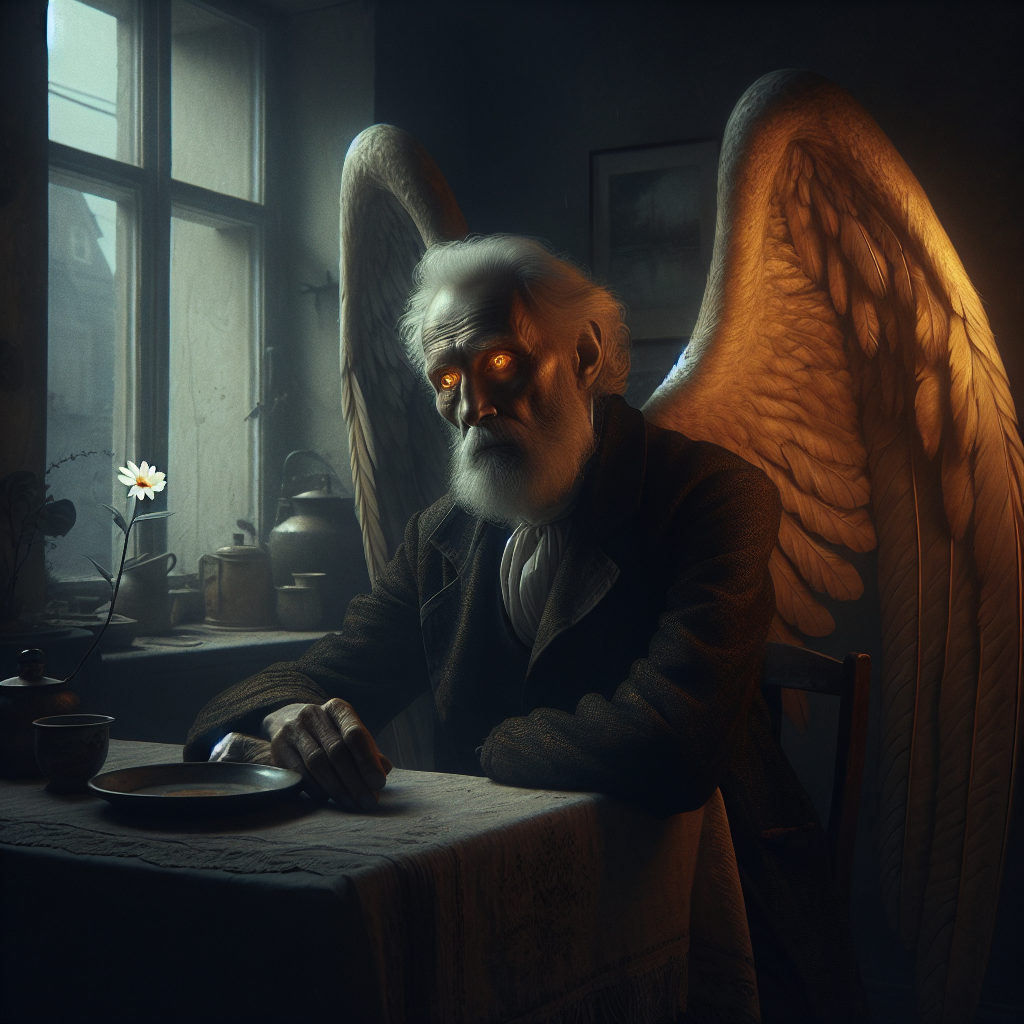
The man was sitting on the front steps of her building when she arrived at dusk, and she noticed him first because of his eyes: they were the color of fire, not metaphorically but actually, a shifting amber and gold and deep red that no contacts could have produced. He was old, or he had the qualities of old — weathered, settled, carrying the weight of duration in the way his body held itself. But he moved when he saw her with a precision that had nothing to do with age.
“Mara,“ he said. Not a question.
“Who are you?“
“My name is Aveth.“ A pause, the calibrated pause of someone choosing how much to say at once. “I heard you speak last night.“
The cold came back. Not the cold of the Vorah — this was her own cold, the mammalian response to threat. “You were in my apartment.“
“No. I heard you from much farther than that.“ He looked at her with those burning eyes, and what she felt was not menace but something harder to categorize: a quality of seeing that was not merely looking. Like being read. “You have not done this before.“
“I read a manuscript —“
“You spoke the First Tongue. You did not mean to, but intention is less important than capacity. You have the capacity. Whatever it was that ran from your kitchen last night — it will have told someone what it found.“
The sun was going down over the city. The towers to the east were catching what light remained, and Mara noticed, despite everything, that the light was a little less washed than usual — that the edges of things were a little sharper than they had been for months. It occurred to her, standing on the steps of her own building with a strange man whose eyes were the color of fire, that this too was connected.
“Come inside,“ she said. “You can explain.“
He followed her up. He did not look like an angel. He looked like a retired schoolteacher, or a very patient doctor. He sat at her kitchen table where the tea stain was still drying and looked at the white flower on the windowsill with something that might have been satisfaction.
“Angels,“ she said, when he'd laid out the basics. “You're an angel.“
“I was not born one. I was sent. The distinction matters to some people.“ He folded his hands on the table. They were ordinary hands — lined, careful, a small scar on the left ring finger that she would later learn was from the war that preceded her civilization. “What matters now is: you can speak, and what you said woke something up, and you are not prepared for what comes next.“
“What comes next?“
“Vael will send something stronger than what you drove away.“
Mara looked at the manuscript pages, still scattered across the table. At the eight syllables she'd circled in red. “Who is Vael?“
Aveth's expression did something complicated. “He was, once, a very beautiful mind. He chose differently.“ He paused. “He has been draining your city for three years. What you experience as grayness — the loss of presence, the fading — is what the First Tongue calls verath: the slow withdrawal of the creative voice from a space. Vael does this not with violence but with patience. He has been doing it to many cities, for a very long time.“
Mara thought of her journal. The mural. The market flowers. The sunsets. “Why?“
“Because he believes the world would be better unmade. Not destroyed — he is more sophisticated than that. Unmade. Reduced to pure matter with no speaking in it, no cost, no loss. He calls it mercy.“
“And you're here to stop him.“
“I have been trying to stop him for longer than your civilization has existed.“ He said it without self-pity, which was somehow worse. “I have not succeeded. But you spoke last night, Mara. The First Tongue, alive in a new Speaker, is a thing that has not happened in this city for forty years.“ He looked at her directly. “Will you let me teach you what you said? And what it costs? And what we are fighting?“
Outside, the city was going dark in the ordinary way of cities at evening. Somewhere in it, she now understood, something was moving that was not ordinary.
She looked at the white flower.
“Yes,“ she said.