CHAPTER EIGHT
The Speaking War
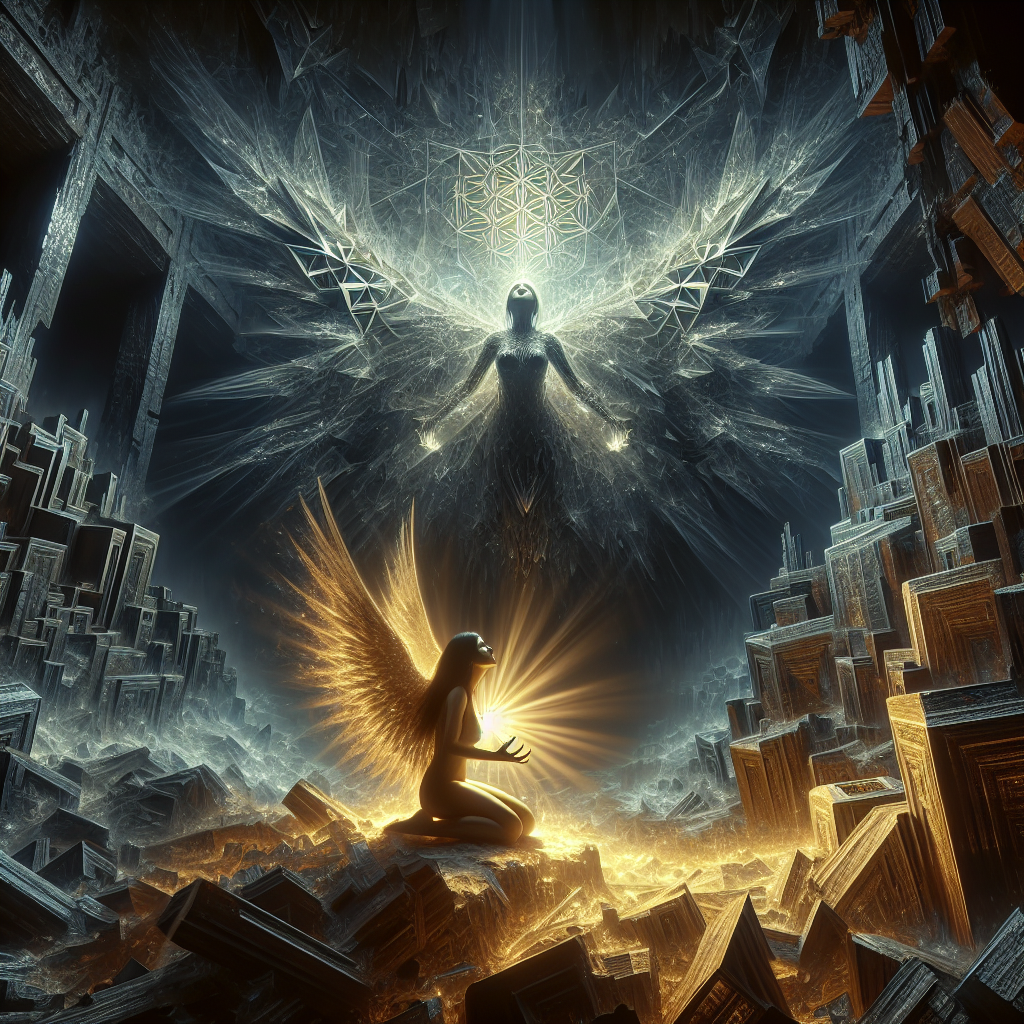
Chapter Eight: The Speaking War
They went at dawn on the third day.
Not to the place of Unmaking. First to the Meridian site — because the ritual structure had to be disrupted from the outside simultaneously with any attempt from within. Aveth had worked out the timing: if Mara and Cael entered the place of Unmaking and began destabilizing the scaffold from inside, while Yse and the remaining Kindled attacked the ritual architecture at the Meridian from outside, the two pressures together might be enough to collapse the whole construct.
“Might,“ Cael had noted.
“The alternative is certain failure,“ Aveth had replied, which settled that.
Mara had spent the night not sleeping but not precisely awake either, lying on the cot in the warehouse and speaking, very quietly, every word she knew, over and over — not to spend herself but to hold herself, the way you hold something fragile by handling it carefully rather than not at all. She had gotten back a portion of her precision. She was not recovered. She was what she was, and she was going anyway.
Cael had told her, at some point in the night, that the cost of a third descent — a third major expenditure — would take him out of approximately twenty-four hours of experience. “I've done the math,“ he said. He was sitting on the floor beside her cot, back against the wall, which was where he'd been for most of the night. “Worst case, thirty-six.“
“That's — “ she started.
“A day and a half I won't remember.“ He shrugged. “Worth it.“
“You can't know that yet.“
“I know it now.“ He paused. “It occurs to me that I should say this now, in case there isn't a later that is — similar to now.“ He looked at the ceiling. “Working with you has been — the thing I was hoping for, when I came to the Kindled, without having any idea what to hope for. The thing that made the reason feel connected to the work.“ He looked down. “That's probably the most oblique confession I've managed in twenty-five years.“
She looked at him. He was looking at the wall.
“I know,“ she said. “Me too.“
He glanced at her. Nodded once.
“Okay,“ he said. “Good. That's — okay.“
Dawn came.
The Kindled split into two groups at the edge of the city's industrial quarter.
Yse led five Speakers toward the Meridian site. She had been conserving for two weeks — barely speaking at all, holding everything for this. She walked with the deliberateness of someone carrying something heavy and important, and when she reached the Meridian's perimeter she would spend everything she had left. Mara watched her go and felt the specific grief of watching someone you care about walk toward a cost they have already accepted.
Yse didn't look back. She knew Mara was watching. She had said what she had to say on the pad.
Mara and Cael went the other way.
The descent into the place of Unmaking was faster this time — she knew the word, knew the quality of the withdrawal, knew the moment when ordinary space released her. It felt less like falling and more like choosing to step outside. She brought Cael with her, his hand in hers, and he was steady the whole way through.
The place of Unmaking was different.
It was in motion.
The architecture that had been patient and dense and static on her first visit was trembling. She understood immediately: Yse had reached the Meridian site. The external attack had begun. From the outside, the physical ritual structure was under assault by five Speakers spending everything they had, and the vibrations of that assault were propagating through the Mindscape connection into the place of Unmaking, the way an earthquake propagates through rock.
The scaffold was unstable.
“Now,“ Cael said.
They moved fast, both speaking — Cael covering distance quickly with a translation-word she didn't know yet that covered ground efficiently, Mara following and speaking stabilization-words ahead of them, opening paths through the structure, because the structure was collapsing in places and they needed it to collapse in the right places, the nodes where the taken names were embedded.
She found Reth's name in two minutes.
It was new to the scaffold, barely integrated, exactly as Aveth had predicted. The unmaking-coating was thin. She spoke Reth's name — just Reth, just the name in the First Tongue, the specific frequency of that patient heavy deliberate person — and the name responded immediately, the way Savi's had but faster, the receiver still warm, barely cooled.
She pulled.
The cost was enormous, but she'd expected enormous and she held.
The scaffold section collapsed.
Reth's name came free.
She didn't have time to do more with it — she held it and kept moving, Cael beside her taking two more — because the place of Unmaking was becoming very loud now, not with sound but with the specific presence-noise of Vael's attention, which was everywhere in this space and was now fully directed toward them.
You again, said the voice, and it was not through a messenger-construct this time. It was direct, immediate, the full weight of him.
The cold hit them like a physical wall.
In the Mindscape overlay, Vael appeared — not as the precise stillness she'd seen before. He was bigger now, in this space where he was at full power, a form that filled the architecture around him the way fire fills a room, present everywhere at once, his darkness not absence but substance, the active darkness of an unmaking that had been going on for millennia.
His eyes found her.
She spoke.
Not the first word. Not any single word. She gathered everything she had and she spoke in sustained full sentences in the First Tongue — which she had never been able to do before, which Aveth had said would take years — and the words came, because the words were right, because she was stating something true and the First Tongue does not allow misstatement when you are speaking from the deepest level of what you know.
She said: You were made to create. You were made to speak things into fullness. Every word you have spoken in inversion is a word that was shaped for its opposite, and that shaping does not disappear. I can hear it in you. The form of you is still the form of creation, even upside down.
Vael stopped.
She kept speaking.
You believe cost is suffering and suffering should end. You are right about suffering. You are wrong about cost. Cost is the thing that makes a word specific. Cost is the thing that makes love different from noise. Cost is the thing that makes me real enough to stand here and say this to you. Remove the cost and you have not ended suffering. You have ended everything.
The darkness in the place of Unmaking shifted. She felt it — not retreat, but something less stable than what it had been. Uncertainty was not a thing Vael had felt recently. She felt that too.
You cannot be real, he said. The voice was less beautiful now and more precise, the precision of something working hard. You have been speaking for six weeks. You cannot know what I know.
“I don't,“ she said. “I know six weeks of it. That's enough to know it's worth paying.“
She spoke the direct-light word.
In the place of Unmaking, this produced something that should have been impossible: actual light. Not the Mindscape-light, not the speaking-glow she could produce there. Real light, the quality that she recognized from the arena when she spoke correctly, the quality that the gray city was missing, the quality that Lena's singing restored to a three-block radius without Lena knowing what she was doing.
It expanded.
The place of Unmaking did not like it. The space contracted, Vael's architecture fighting back, the darkness pressing against the light with the full weight of centuries of practiced inversion.
Cael spoke.
He spoke everything at once — the coiled potential she had always sensed in him, released entirely, in one continuous sequence that was not strategic but absolute. Everything he had, everything he hadn't spent in two years of careful conservation, everything he'd held back for exactly this. In the Mindscape, his speaking was a structure of such compressed light that it was almost blinding, a star's-worth of potential becoming actual.
And the cost: she heard him cry out, once, in the physical plane — felt his presence stutter beside her, the thirty-six hours she'd feared beginning to claim him, his experience of the present starting to leave.
“Cael,“ she said.
“Still here,“ he said. His voice was from very far away. “Keep speaking.“
She kept speaking.
Vael pushed back with everything. The whole place of Unmaking became a pressure, a focused unmaking directed entirely at them: not at their names, which she was protecting, but at the light itself, trying to consume it before it could spread further. She felt the conflict as physical — her chest aching, her vision blurring in ways that had nothing to do with the cost of speaking, the edges of herself thinning under the pressure.
She spoke the first word again.
I am here. See me.
And the answer came.
Not the brief warmth she'd felt before — that fingertip brush of the Rational Ground's attention. This was — she did not have a word in any language, including the First Tongue, for what it was. It was the thing the First Tongue was always pointing toward, the thing all words were reaching at and never fully arriving at. It entered the place of Unmaking and the darkness was not destroyed — she understood it was not meant to destroy — but it was addressed. Spoken to. Named.
The effect on Vael was something she had not anticipated.
He went still.
Not the stillness of stopped motion. The stillness of someone who has heard something they had not expected to hear. She looked at him — at the ancient form of darkness-made-deliberate — and saw what she had sensed in his voice the first time they had spoken: the shape of what he had been, before the inversion. The creative form. The frequency shaped for amplification.
She spoke his name.
His actual name — his original name, the name he had been given before the First War, the name she had not known she knew until she spoke it, until it came out of her the way the first word had come out of her in the kitchen, because it was already there, because the First Tongue contained it, because names do not disappear even when they are inverted.
Vael made a sound.
It was not in the First Tongue. It was not in the language of unmaking. It was a sound with no grammar, no structure, no intent — the sound of something being found after a very long time of being lost, against all expectation and all calculation.
And then the scaffold collapsed.
The whole structure, the years of preparation, the careful lattice of unmade names — it came apart in the wave of light and the naming and the pressure from outside where Yse and the Kindled were spending everything. The load-bearing elements could not hold: the recovered names were gone, the architecture was destabilized from within and without, and Vael was not directing its maintenance because Vael was very still and very silent.
The taken names — all of them, everyone in the scaffold — came loose. Disoriented, damaged, barely coherent, but free.
She gathered them. All of them. Held every one. It was more than she had ever held, more than she knew how to hold, and the cost was catastrophic — she felt herself going so blurry she couldn't find the edges of herself at all, couldn't identify where Mara stopped and the accumulated names began.
“Mara,“ said Cael. His voice was very distant.
“I have them,“ she said.
“Come back.“
She spoke the exit-word.
The place of Unmaking released them — slowly, fighting, the architecture of centuries dissolving into the incoherence of ordinary space, the structure that had been the ritual's foundation collapsing as they went, taking its carefully assembled unmaking with it.
They came back.